

Years after their first attempt at console gaming, Valve has officially returned to the living-room gaming arena with its new Steam Machine. Announced just a couple of weeks ago, the SteamOS powered console-style gaming PC represents Valve’s biggest hardware push yet.
Here’s what we know so far.
What is the Steam Machine?
The new Steam Machine is a compact console-form gaming PC built by Valve. Dubbed as “The GabeCube” by many, it runs SteamOS and is designed to sit stylishly and stealthily beneath your TV or in a media centre.
Unlike the scattered OEM “Steam Machines” of 2015, the new 2026 version is a single unified device made directly by Valve, and boasts performance which is six times better than the Steam Deck according to some sources.
Specs & Features (so far)
While teardowns are still yet to happen, here are headline specs and features we know of so far:
- CPU: AMD Zen 4 (6 cores / 12 threads, up to ~4.8 GHz)
- GPU: Semi-custom AMD RDNA 3 with ~28 Compute Units and dedicated VRAM (~8 GB GDDR6) targeting 4K60 performance.
- Memory/Storage: 16 GB DDR5 system memory + 8 GB dedicated VRAM; storage options include 512 GB or 2 TB NVMe SSD, which can be replaced/upgraded by the user. Expansion via microSD supported.
- Display/Output: Supports HDMI 2.0 and DisplayPort 1.4; aims for 4K gaming at 60 fps (or more) with FSR upscaling and modern features like HDR and FreeSync.
- OS & Ecosystem: Runs SteamOS like the Steam Deck, meaning your Steam library (and Proton compatibility for Windows games) is central.
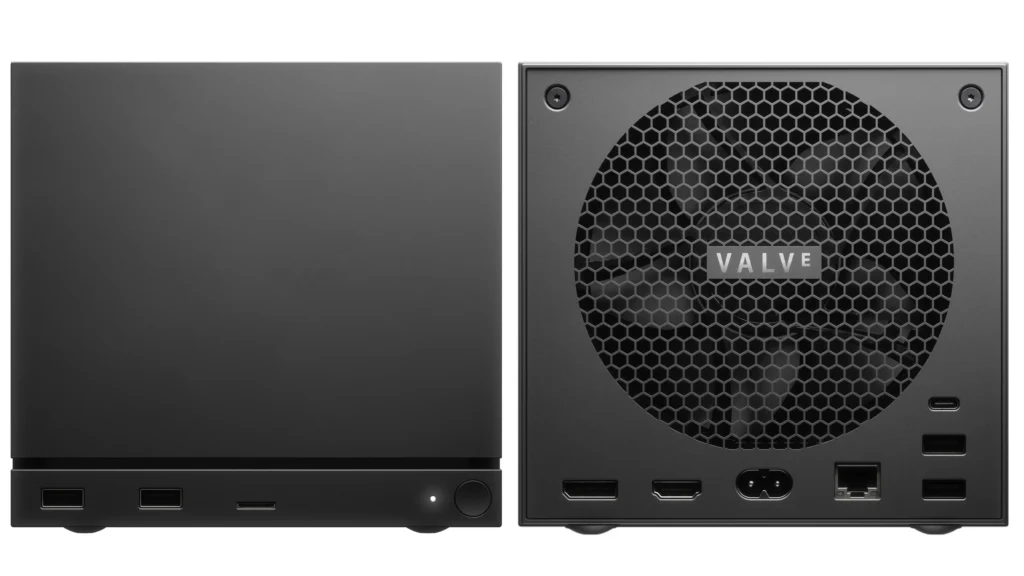
Credit: Valve/Eurogamer
How It Compares to Current Consoles & PCs
The Steam Machine sits with the current generation consoles in terms of power, but its graphics put it a little behind PS5 and Xbox Series X, with some saying that it leans more towards the PS5 in terms of general performance.
When compared to PCs, Valve says the graphical performance is similar to that of an AMD 7600 XT. However, they were quick to point out that the comparison might not be as apples to apples given their custom software stack and tuning. Essentially, Valve’s aim is to be able to run everything at 4K 60fps, assuming you’re willing to turn down some graphic settings and use FSR upscaling.
The Pros of the Steam Machine
If you’re an avid PC or Steam Deck gamer, with a large Steam library, the Steam Machine may prove to be of value to you if you’re looking for a less janky living room gaming solution. Its sleek design paired with the familiar Steam OS should give a great out of the box experience much like Sony and Microsoft tend to do.
Another plus is that the Steam Machine is, at its heart, still a PC. This means that it could be treated as any other desktop or HTPC to stream media or straight up installing another operating system on it.

Credit: Valve
Potential Pitfalls
Valve has stated that the Steam Machine is in itself a PC, and as such, pricing will compete with PCs. What this means is not exactly known, but many fear that the price of the Steam Machine may not be representative of what it actually offers, especially given the recent tariffs in the U.S. and the surge in RAM and SSD prices.
Keep in mind that SteamOS is Linux-based, many games with anti-cheat are still not supported, so if your favourite games require anti-cheat, you may be down on your luck.
The Verdict
If you’ve been entertaining the idea of a living room PC, Valve’s new Steam Machine is one of the most interesting upcoming devices for the job. I’ve fallen in love with the geometric design, and having PC capabilities in a console packaging is nothing short of intriguing.
If Valve can strike the right price and deliver good game compatibility out of the box, this could become a go-to choice for folks who want the simplicity of consoles and the freedom of PCs. For now, all we can do is cross our fingers, and keep our eyes out for a launch date.